
Hugo RibaudAI consultant and trainer in Marseille, freelance developer
I train your teams on AI and set up systems that run on your real files. If a good configuration does the job, I won't sell you an application.
What I Do
Training, consulting, development. We start from your actual tasks, you leave with a system running on your own machine.
Article 4 was rewritten on 27 July 2026
AI literacy (art. 4 AI Act): training and dated records
An inventory of how your teams actually use AI, a 3-hour session built on it, and a dated file delivered within 5 days.
AI Consulting & Support
From "I don't know where to start" to a system that works
An audit of your repetitive tasks, setup of a personalised AI system, and support until you're autonomous. You leave with tools that work: automated meeting notes, pre-drafted emails, simplified monitoring, custom workflows. Monthly support available afterwards, from €300/month (3-month minimum). Reduced rates for non-profits and social economy organisations.
AI Training
Become autonomous with AI tools, at your pace, at your level
Hands-on training for professionals who want to master AI without technical jargon. From beginners discovering ChatGPT or Claude to power users automating their workflows. Individual or group, every session ends with practice on your own cases. Depending on eligibility, French professional training funding (OPCO) may cover individual and standard group sessions, and I handle the paperwork. AI Mastery (art. 4) is decided on a compliance budget instead, with no funding application to put together.
Custom Development
Web apps, mobile apps and business tools, built to last
I build the tools your teams will actually use. Web applications, mobile apps, business platforms, with a modern stack, controlled hosting costs, and your data sovereignty in Europe.
Starting at €3,000
Case Studies
Real results
AI Training
Automating outreach for a media SME
3,000 creators to contact, one person in marketing, and personalised emails written by hand. The volume made the whole thing impossible to sustain.
A pipeline built with her, session after session: her spreadsheet triggers the send, the AI drafts the email from the channel's data, the mailing tool sends it and marks the row as handled. She drives all of it from her spreadsheet.
Technical details
Problem Statement
The marketing lead had to reach 3,000 content creators with a message tailored to each profile, alone and without technical skills. Three segments coexisted, each with a different commercial approach. Writing each personalised email by hand took time the volume simply didn't allow, and generic personalisation produced no replies.
Technical Approach
- Session 1: architecture of an automated outreach workflow, chatbot subscription versus API, hands-on with the orchestration tool on a real case
- Session 2: building the end-to-end pipeline and writing the per-segment prompts, on test data
- Session 3: full run validated, and a deliberate call to pause web enrichment in order to launch on a simple, well-understood foundation
- Session 4: connecting the pipeline to her own spreadsheet, duplicate-send protection, official signature, controlled test emails
- Ongoing support: written recap after every session, versioned standard operating procedure, sending guardrails while the system is in test
Technologies Used
Orchestration
IA
Envoi
Pédagogie
Key Learnings
- In hands-on training, what each session ships matters more than the syllabus: the trainee has to leave with something that runs
- The trainee creates her own accounts, API keys and connections. In the fourth session she was the one who caught a formatting trap before it happened, an amount that would have turned €3,200 into €3.2, because she had run into it elsewhere. That's the point where training flips: she stops executing and starts checking.
- Cutting an appealing but fragile component (web enrichment) to launch on a simple foundation saved two weeks
- Data sovereignty came up at the kick-off, not at the end: for an SME, knowing where the data lives is a prerequisite, not an extra
- A spreadsheet as the control panel is what makes the system genuinely autonomous: she decides who gets contacted, without going through me
AI Consulting
AI setup for an executive on a transition assignment
An executive on assignment, alone on his reporting and monitoring, with no time to learn complex tools.
A working environment built on his own documents, then three automations built together with him, and a monthly engagement that evolves them as his assignments change.
Technical details
Problem Statement
The executive handled his board communications, risk tracking and opportunity monitoring by hand. Each task took a disproportionate amount of time, and nothing in his daily work told him where AI could concretely help.
Technical Approach
- Audit of recurring tasks and setup of the working environment on his real documents, on his own machine
- Three automations built with him: assignment risk radar, board communication, end-of-assignment report
- A weekly briefing, scheduled and prepared automatically before his week starts
- Monthly follow-up: syncing his workspace across two machines, and adapting the automations to each new assignment
Technologies Used
Outils IA
Méthode
Key Learnings
- Non-technical profiles often get the best results: they have no preconception of what AI 'should' do
- Working on the client's real files from minute one removes the abstract demo phase entirely
- The clearest return is on recurring reporting, because that's where the task repeats identically
- A monthly engagement only works if the client builds alongside you, otherwise it turns into support instead of evolving the setup
Sagittarius
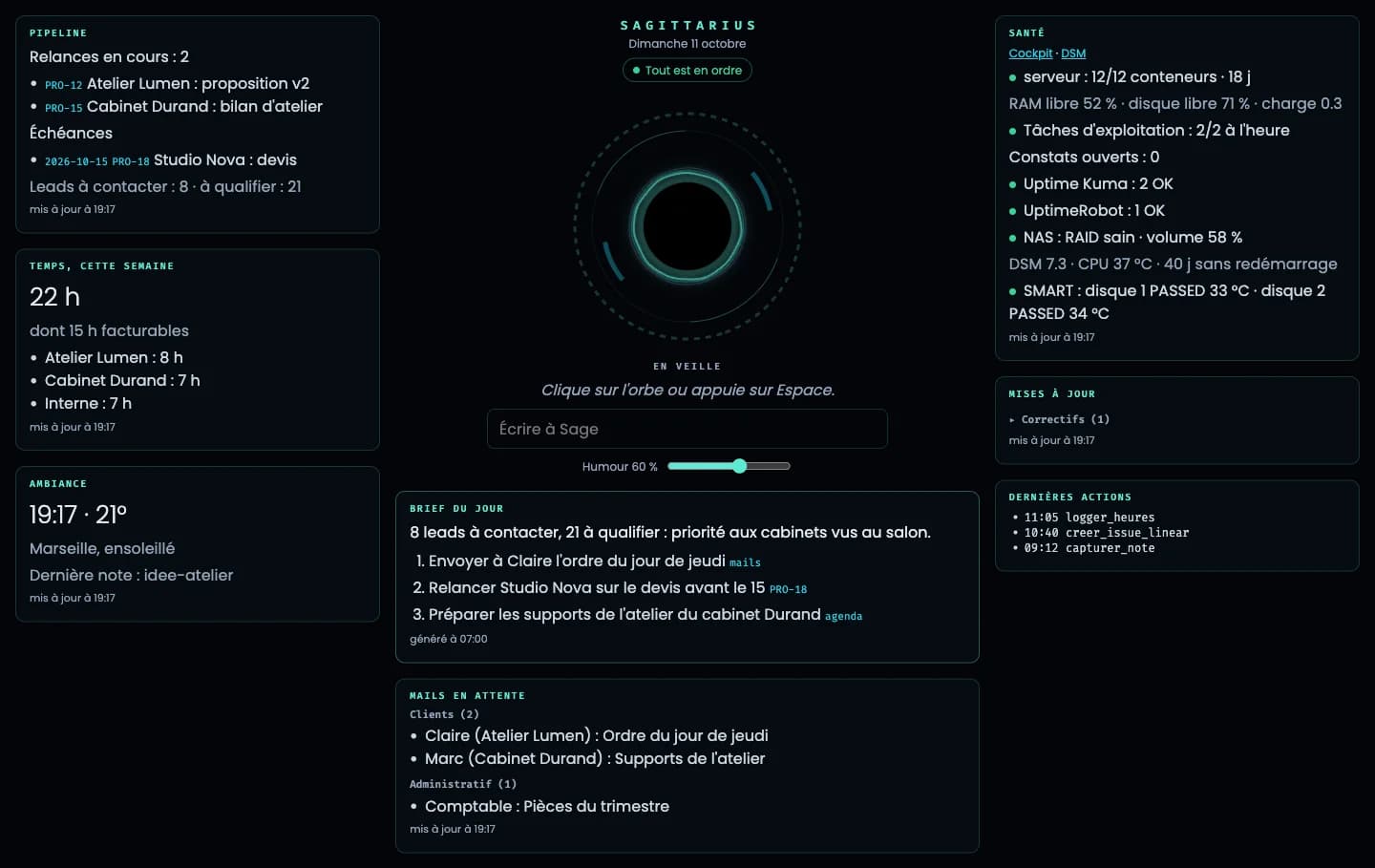
A voice assistant and personal cockpit, hosted on my own infrastructure
My work information was scattered across a dozen tools, and every day started with a tour of all the tabs.
One screen and one voice to check and capture everything, hosted on my server and reachable from my private network only.
Technical details
Problem Statement
Emails, calendar, leads, tickets, notes, server monitoring: each tool has its own interface, and nothing connects them. Consumer assistants can't see these tools, or ask to be handed every access. I wanted an assistant wired to my own sources, hosted at home, and unable to do anything I hadn't planned for.
Technical Approach
- Spec, mockups and implementation plan written before the first line of code, then development driven by AI agents, reviewed at every step
- Connectors to email, calendar, CRM, Linear, Obsidian notes, weather, monitoring, and server and NAS updates
- A voice agent with 15 tools: look up, search, capture a note, create a ticket, log time
- Security first: no public access (Tailscale private network), identity check, unprivileged container, and the most sensitive credentials read by the host server instead of being handed to the app
- Continuous deployment after every integration that passes the tests, with no expiring access key (OIDC identity federation)
- Transparency about data flows: voice goes through ElevenLabs and reasoning through Claude (Anthropic), outside France. These services see the content of the conversations and the brief, never the tools' credentials
Technologies Used
Application
IA
Sources
Infra & qualité
Key Learnings
- Writing the spec before the code changes the pace: the fundamental questions are settled before the first line, and every trade-off stays on record (66 in the v1 review)
- An assistant that acts needs a written scope: each voice tool does one precise thing, and nothing else
- Security is decided in the architecture: a network shared with other services would have been enough to bypass the identity check
- Sovereignty has to be stated plainly: high-quality voice currently goes through services outside Europe, and the client should choose knowingly
Conversari
4 applications in production for €13 a month, data hosted in Europe
Aging Java/Spring Boot legacy system, expensive to maintain. The association needed a modern ecosystem for their mediation and training activities.
4 web applications delivered and hosted on European infrastructure I operate myself: around €13 a month all in, backups and monitoring included. The legacy Java system was migrated with no downtime for the association.
Technical details
Problem Statement
The association was running on an aging Java/Spring Boot 2.7 + Vue.js legacy system that was expensive to maintain and limited in features. They needed a modern ecosystem covering their various activities (mediation, training, debate) with reliable and cost-effective infrastructure. Additionally, 255 reflection questions were managed in Google Sheets, unusable during training sessions.
Technical Approach
- Complete migration from Java/Spring Boot 2.7 + Vue.js to Next.js 16 + Supabase, planned in 7 phases
- Multi-application architecture: Argumenter (complex business app with classes, arguments, challenges, real-time votes, QR codes), Logos (toolbox), Réfléchir (debate roulette with 255 topics), Website (showcase)
- Réfléchir: migration from Google Sheets to Supabase PostgreSQL, interactive SVG roulette, live projection mode for training, admin dashboard
- Self-hosted VPS infrastructure: Docker containers behind Caddy, API gateway moved from Kong to Envoy in August 2026 with no downtime
- Self-hosted multi-tenant Supabase: data isolation through Row-Level Security and RPC functions, PostgreSQL upgraded from 15 to 17 in June 2026
- Automated monitoring: Beszel, Uptime Kuma, Sentry, scheduled health checks, backups and restore tests
- Real-time alerts via ntfy for incidents and backups
- CI/CD with GitHub Actions for automated front-end app deployments
Technologies Used
Full-Stack
Backend
Infrastructure
Monitoring
Key Learnings
- Migrating a Java/Spring Boot monolith to Next.js + Supabase without downtime comes down to rigorous phase-based planning
- Self-hosted multi-tenant Supabase requires careful API gateway and GoTrue configuration for data isolation
- Automated monitoring is essential for reliable self-hosted infrastructure
- Caddy greatly simplifies TLS/HTTPS management compared to Traefik for small infrastructures
- A 4-app ecosystem can run for around €13/month on a well-configured VPS
- Transforming an existing client tool (Google Sheets) into a web app reduces the adoption curve to zero
- Live streaming mode requires fine-grained state and animation transition management
SmartApp
International Camp Management Platform
International camps managed everything on paper and Excel: menus, events, emergency contacts. Each new site took weeks to set up.
Mobile app + web CMS built solo. Multi-tenant architecture enabling new site deployment in less than a day, with offline mode for isolated areas.
Technical details
Problem Statement
International camps managed everything on paper and Excel: restaurant menus, event programs, emergency contacts, announcements. Each new site required weeks of configuration. Residents constantly harassed the front desk for basic information, and low-connectivity areas made traditional cloud solutions unusable.
Technical Approach
- Multi-tenant architecture enabling new site deployment in less than a day with full customization
- React Native/Expo mobile app with offline-first support for limited connectivity areas
- Next.js web CMS allowing non-technical teams to manage content autonomously
- Supabase real-time synchronization for urgent announcements and updates
- Push notification system for instant communication with residents
- Robust REST API with offline sync conflict management
- Infrastructure with Supabase PostgreSQL database
Technologies Used
Mobile
Web CMS
Backend
Infrastructure
Key Learnings
- Well-designed multi-tenant architecture from the start enables massive scalability without rewriting
- Offline-first mode is crucial for field applications - connectivity should never be assumed
- An intuitive CMS drastically reduces support requests and empowers teams
- Managing a solo project of this scale requires rigorous discipline and modular architecture
- Real-world testing (isolated camps) reveals edge cases impossible to anticipate in development
Your data stays in Europe
Sovereign hosting, no dependency on US clouds
I offer a concrete alternative to the US cloud giants. Your data sits on European servers, out of reach of the CLOUD Act. This isn't a marketing promise: it's infrastructure I run myself, in production since 2026.
Outside the CLOUD Act
Your data hosted on European servers, with no transfer to the United States. GDPR compliance by design.
From €13 a month
One European server hosts several applications at once, backups and monitoring included. Your bill doesn't double every time you put another tool live.
Operated, not outsourced
Continuous monitoring, real-time alerts, verified daily backups. I hold the infrastructure myself, not one more subcontractor.
10 years in hospitality + 8 years in development : CIS, Cap4 Lab, MyCTOFriend, Freelance
View my background on LinkedInAbout
I change the way professionals work with AI. I spent 10 years managing clients in international hospitality, then 8 years building applications. That crossover means I understand both the business side and the tech, and I translate one into the other.
From "I don't know where to start" to an AI system that saves you hours every week.
I audit your repetitive tasks, set up a personalised AI system, and support you until you're autonomous. You leave with tools that work, not a manual to read.
- •Every meeting summary takes you 45 minutes to write
- •Your follow-up emails keep piling up endlessly
- •You've heard about AI but don't know where to start
- •You're paying for an AI tool you only use at 10% capacity
Let's discuss your needs
Whether you want to train your team, bring AI into your daily work, or build a custom tool, we start with 30 minutes to understand where you stand.
Book a 30-min slot